The Concept of Decision Making
“We all make mistakes. If you can’t make mistakes, you can’t make decisions. I’ve made a lot bigger mistakes myself.” – Warren Buffett
Its time to sharpen your decision making and minimize your mistakes.

What is Decision Making?
Decision making is a process – A process that allows us to deal with situations that demand us to choose amongst several options.
The Significance of Decision Making
The goal with every decision is to get the right results. Right decisions lead to right results. Thus, it is necessary to have an understanding of how decision-making works?
We can visualize the significance of decision-making process as follows:
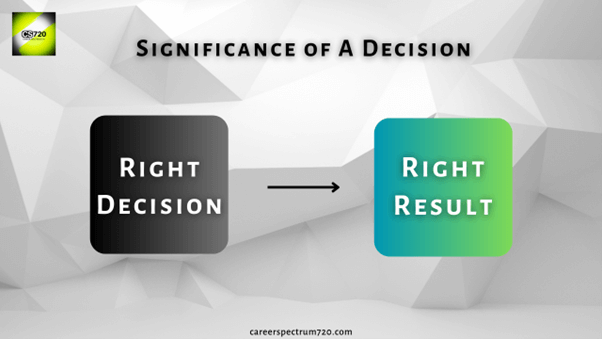
The goal is always to make decisions that lead to the right results. When we make bad decisions, it cost us dearly. The costs associated with any decision escalates in proportion to the impact of the decision.
But, really, how costly can bad decisions be?
In 2018-2019 Boeing decided to operate its Boeing 737 Max planes. During the same period 2 fatal crashes led to the death of 346 passengers.
The airworthiness of the planes was revoked and by March 18, 2019, all 387 of the aircraft in service were grounded.
The two fatal crashes cost Boeing not only reputation but also serious money – up to the tune of $20 Billion (direct cost).
Boeing, the company behind 707, 727, 737, 747 and 757 (5 most successful commercial jets) was now in a very questionable spot.
However, it is not only money that a terrible decision can cost you. The impact of a bad decision spills into other areas too.
Impact of a Bad Decision
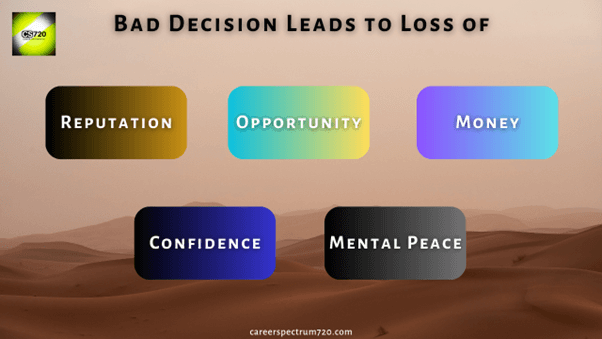
A bad decision can lead to a loss of:
- Reputation – Aviation is a sector in which passenger safety is paramount. Boeing’s reputation took a massive hit with the crash of its 737 Max planes.
- Opportunity – Following the crash, several airlines across the world paused the purchase of the 737 Max planes, citing safety concerns.
- Money – Boeing lost up to $20 Billion.
- Confidence – Airlines, pilots and passenger lost confidence in Boeing’s ability to deliver airworthy planes. Airlines didn’t want to buy them. Pilots didn’t want to fly them. Passengers didn’t want to travel on them.
- Mental Peace – Boeing was in a turmoil as it started pointing fingers at other sub-contractors, even though it was entirely Boeing’s responsibility to deliver an airworthy product.
Some costly mistakes in business history:
- British Petroleum (Deepwater Horizon disaster) – $68 billion.
- Volkswagen (Emission scandal) – $38 billion.
- Boeing (737 Max grounding) – $20 billion.
From the above list it is safe to conclude that even seasoned professionals need to revisit their understanding of decision making.
A poor understanding of decision making can lead to very difficult moments and often organization and people are unable to recover from some of the bad decisions they have made.
Decision Making as A Discipline
It is no coincidence that London School of Economics offers a dedicated on-campus module on this subject. Decision making is a critical skill set and leaders at all levels of high-function organizations struggle to master it.
A good program on decision making will do the following:
- Help you understand the basic concepts in decision making.
- Equip you with the right tools to aid your decision making.
- Sharpen your critical thinking.
Decision makers are not fortune tellers. There is no crystal ball that is going to help you ace the outcomes. However, it is possible to improve your chances of success, simply by improving your understanding of the subject.
For example, at a personal level good decision making will lead to better health decisions. You start paying attention to what food you consume and how often you exercise.
At a professional level, you will make better career choices. Also, when collaborating with other individuals in groups, you will make better contributions.

Decision Fatigue
Given the plethora of choices at the disposal in the modern world, people struggle with decisions so much so that we actually get exhausted from having to decide too much.
This phenomenon is called decision fatigue.
When Steve Jobs rejoined Apple in 1997, the first thing he did was to shrink the number of products from 350 to 10. He wanted to focus on the core products and deliver superior devices to customers. In January 2024, the iPad line-up alone would have made you scratch your head.
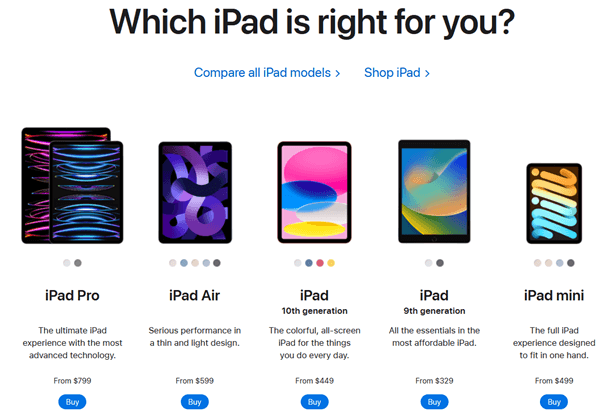
It is no secret that Apple’s modern product lineup is a bloated mess.
When you start factoring in the storage size, the connectivity options, the peripheral devices such as the keyboard and the Apple pencil, amongst other options, you will realize how difficult it is to actually buy an iPad.
We now inhabit a fast-paced world that is full of ever-growing complexity. Decision fatigue is a natural outcome of such an environment.
Simple Decisions vs Complex Decisions
Simple decisions are simple. You are thirsty, you drink water.
It’s an easy problem to solve, unless, you have to choose from 10 different kinds of packaged drinking water.
Complex decisions pertain to difficult problems that need to be solved. These are not every day occurrences.
For example, when you have to buy a car, you start factoring in the various options that you have. You start with the amount of money you are willing to have and stack it against your expectations. What features do you wish to have for that amount of money.
Next, you start looking for cars that offer those features in your desired price range. Further, you also need to consider whether you really need a car? Is the maintenance cost and hassle associated with car ownership acceptable to you? If you forgo the purchase, will the public transportation cover your needs?
Buying a car is not an everyday decision. That’s why this will be classified as a complex decision.
In contrast, deciding what you will have for breakfast will be a simple decision since you run through this task daily.
Needless to say, with complex decisions, mistakes are more costly.
It is impossible to have sound knowledge of all dimensions. That’s why we go to experts when we need to make critical decisions in life.
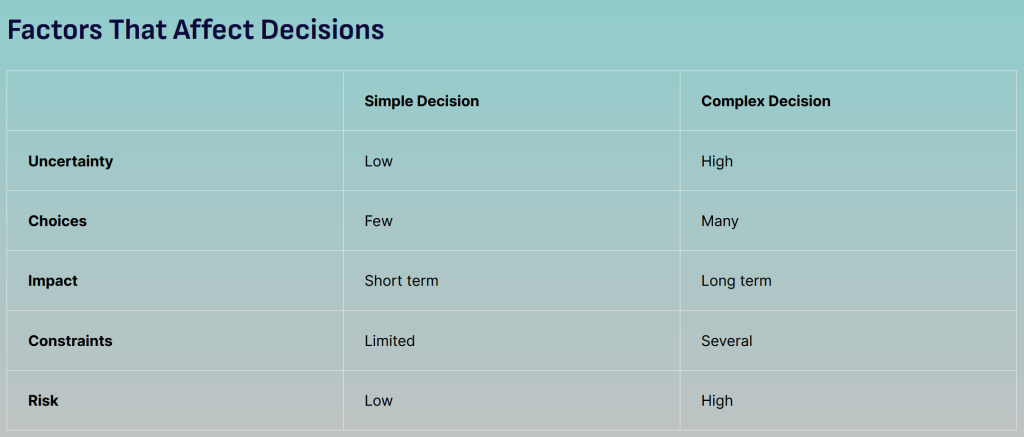
Uncertainty: Nothing is guaranteed in his world, however, with many decisions there are reasonable degrees of clarity. E.g. you are in London and it’s raining. You use an umbrella. But what if it’s really windy? You will need more than an umbrella. Let’s say public transport is on strike. Now you have to take an Uber. The wait time for your Uber is high due to the unfunctional public transport and terrible weather. Now what? Maybe you should postpone your outing.
As the number of factors that can have an impact on your decision go up, it gets difficult to choose.
Choices: As demonstrated in the iPad example earlier in this article, beyond a certain point, the number of choices start working against the customer.
Impact: Buying an ice cream is a short-term decision. You can buy another flavour if you are dissatisfied. However, if you’re are buying a home, you can’t just swap it for another one. Buying property is a high-impact decision. Its consequence last for a long term.
Constraints: When you try to shortlist an institution for higher education, you will run into many roadblocks ranging from course fee to the country you have to move to. Various constrains such as education loan, language barrier etc. will weigh you down.
Risk: Complex decisions are associated with high-risk scenarios. The decision to leave a well-paying job and launch a start-up will be considered a risky move.
Decision Making Frameworks
To tackle such complexities, it is necessary to work with frameworks. One such framework is the Explore-Exploit framework. When time is not an issue, you explore your options.
For example, if you want to go out to eat, instead of going to a tried and tested restaurant, you should consider trying a new eatery. This helps in expanding your knowledge base. If you end up at a good restaurant, you can bookmark it for future use.
However, if you have a terrible experience, you now have the awareness that you need to avoid this particular place. In contrast, if time is limited, you must exploit your past experience and go to a tried and tested restaurant. This approach gives you reasonably acceptable results.
Just like other things in life, this explore-exploit framework can be used to take decisions in other areas of life too. With time being an important factor with almost all decisions, for every decision maker this is a very handy tool.
4X Your Decision Making
Imagine if your decisions had no real-life consequences.
Its possible in the realm of 4X.
4X is stands for eXplore, eXpand, eXploit, eXterminate. It’s a sub-genre of strategy games.
Scientific research, economics, diplomacy, and social dynamics are some of the simulations you will be running through in a 4X game.
In the study “Good gamers, good managers? A proof-of-concept study with Sid Meier’s Civilization” researchers concluded the following:
“Our study suggests that video games such as Civilization can be used to assess problem-solving skills and organizing-and-planning skills – skills that are highly relevant for managerial professions.”

Civilization is a long-standing series of strategy games in which players move in turns, just like chess.
Essentially, Civilization VI tasks players with the challenge of building an empire and pursuing one of the many available paths to victory.
From choosing which technology to research to where to expand your empire to whom to trade with, you will be faced with numerous choices and your decisions will have both short-term and long-term consequences. Bear in mind though, that civilization has a steep learning curve and is a game that is going to reward the patient player.
In this 4X strategy game you will witness how certain decisions play out without any real world repercussions.
Getting Decision Making Right
When decisions do go right, they lead to extra-ordinary outcomes.
Some famous decisions in business history:
- In 1996 Apple‘s board made the critical decision to acquire NeXT and bring Steve Jobs back into the company. Apple’s revenue in 2011, when Steve Jobs resigned as CEO, was north of $100 billion.
- In 2006 Google bought YouTube in a $1.65 billion deal. In 2022, YouTube’s revenue was $29.2 billion.
- In 2012 Facebook bought Instagram for $1 Billion. In 2022, Instagram generated $51.4 billion in revenue.
To further your understanding of decision making you don’t have to travel to UK or some other part of the world.
You can sign up for Career Spectrum 720’s upcoming course on decision making Q2 2024.

Sharpen Your Thinking
Get Notified About the Upcoming Course on Decision-Making.
Submission Successful
In the meantime, sharpen your decision making by studying the CS720 Repository.